NODEIQ ANDROID EXPERIENCE
The motorcycle in your pocket.
Scan the system, see every node, record the route, and—when the future ignition system is installed—commission the engine and manage validated timing maps.
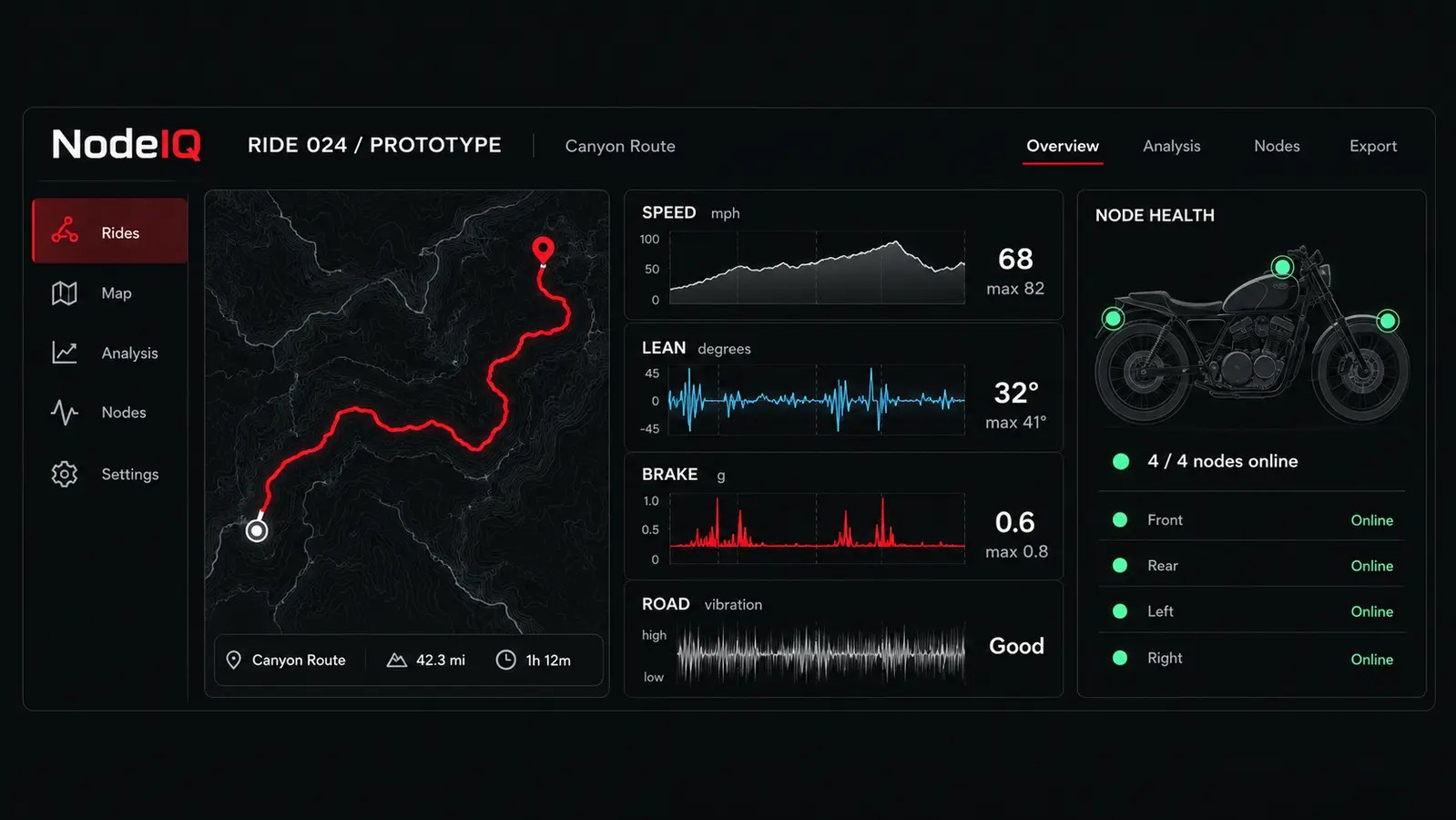
Core experience
Scan for System
Find the NodeIQ hub and establish the phone connection.
Nodes
See connection state, battery state of charge, and signal strength.
Ride Log
Save route, telemetry, diagnostics, and rough-road events locally.
FUTURE EXPERIENCE / IGNITION STUDIO
Detect. Verify. Map. Monitor.
Ignition Studio is the planned commissioning and calibration workspace for the hardwired NodeIQ ignition module. The app manages configuration through the hub; the ignition controller retains deterministic local control of spark timing.
Automatic commissioning
Observe trigger activity, identify cylinder count and trigger pattern, propose a compatible baseline, then guide the installer through base-timing verification.
Timing-map control
View RPM-and-load tables, compare profiles, make bounded edits, stage changes, record map versions, and roll back to a validated configuration.
Live ignition health
Monitor RPM, commanded advance, dwell, synchronization, voltage, map version, and diagnostic faults alongside the ride record.
Guarded by design
Map changes will require explicit review and application, enforce configured timing and dwell limits, preserve a last-known-good map, and leave the ignition module operational if the wireless link is lost.
Future-development interface. Automatic detection and map editing do not replace qualified installation, timing-light verification, dyno validation, or engine-specific limits.
Telemetry
Speed, lean angle, acceleration, braking events, tire pressure, fuel level, ride quality, and future ignition advance, dwell, synchronization, and map version.
Map
Route history, GPS speed, location, prior-ride visualization, and—separately—versioned ignition timing maps for validated configurations.
Diagnostics
Connection properties, network devices, node batteries, signal quality, ignition faults, trigger sync, voltage, and fallback state in one place.
Calibration is an active validation focus
IMU orientation correction, acceleration rejection, chassis-vibration baselining, and ride-data logging remain under test. The future ignition path adds trigger-pattern detection, base-timing verification, timing and dwell accuracy, map safeguards, and fail-safe recovery to that validation program.
 NodeIQ